


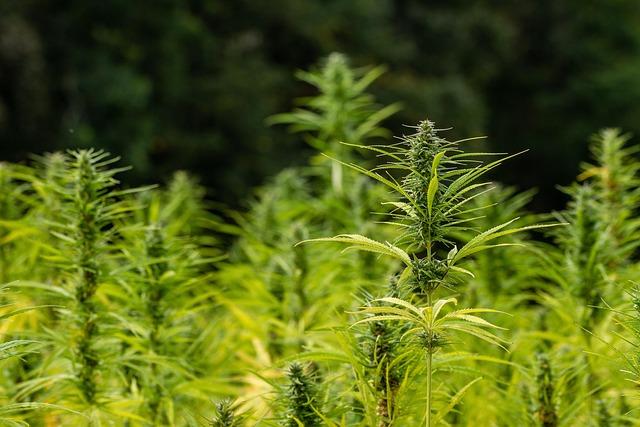
Like a plant caught between two definitions,THCA sits at the intersection of science,law and commerce – a molecule that is chemically kin to THC yet behaves differently until heat or time unlocks its psychoactive sibling. As hemp growers, manufacturers and regulators trace the threads of federal statutes, state rules and court rulings, they confront a question that is at once technical and consequential: when does THCA count as “hemp” and when does it stray into controlled-substance territory?
This article untangles that question by following the trail from laboratory benches to legislative texts. You’ll find a brief guide to what THCA is,why decarboxylation matters,and how the 2018 farm Bill’s 0.3% Δ9-THC threshold-along with varying state approaches and recent legal challenges-has produced a patchwork regulatory landscape. Neutral in tone but attentive to complexity, the piece aims to give readers the context they need to understand the evolving U.S. legal status of THCA as hemp and the practical implications for producers, consumers and policymakers.

Laboratory Science and Decarboxylation Risks: Ensuring Accurate THCA Measurement and Reporting
Laboratory science sits at the heart of the THCA-as-hemp conversation as a sample’s story can change with a little heat. THCA is inherently unstable under thermal stress and can decarboxylate into delta-9 THC during drying, grinding, extraction, or analysis-turning a compliant hemp sample into a legally problematic one on paper. Accurate measurement thus requires not only sensitive instrumentation but also protocols designed to prevent inadvertent conversion and to characterize how much conversion might already have occurred.
Practical safeguards reduce risk and build defensible reports. Key actions laboratories take include:
- Prefer HPLC or LC-MS for native cannabinoid profiling, as these techniques quantify THCA without applying heat.
- Control sample handling – minimize grinding,avoid high-temperature drying,and store cold/dark to limit spontaneous decarboxylation.
- Validate conversion factors and stability with matrix-specific studies so reported totals account for real-world transformations.
- Report method details and uncertainty alongside results so regulators and clients can interpret THCA vs.converted THC with context.
| analytical Method | Decarboxylation Risk | Best Use |
|---|---|---|
| HPLC / LC-MS | Low | Native THCA quantification |
| GC (no derivatization) | High | Not recommended for THCA |
| GC with derivatization | Moderate | Possible with careful controls |
| Stability Studies | N/A | Essential for correction factors |
Beyond lab benches, the way results are reported can change legal outcomes. Laboratories that provide both native THCA values and the calculated potential delta-9 THC (using validated conversion factors and clear uncertainty ranges) give growers, processors, and regulators the openness needed to make reliable decisions.In short, rigorous methods, careful handling, and clear reporting turn a fragile molecule into robust evidence.

State Variations and Enforcement Realities: Mapping Where THCA Is Treated as Hemp or Controlled
Across the United States the legal treatment of THCA looks less like a single map and more like a quilt stitched from different legal fabrics. At the federal level the 2018 Farm Bill established a hemp benchmark built on “total THC” calculations (wich account for THCA’s potential to decarboxylate into delta‑9 THC using the 0.877 conversion factor). States diverge in whether they adopt that total‑THC approach, measure only delta‑9 THC, or write separate rules that explicitly include or exclude THCA. The result: a product that is clearly compliant in one jurisdiction can trigger enforcement in another depending on how regulators, labs, and prosecutors read the formulas and tests.
Enforcement on the ground is driven by a handful of practical realities that producers and consumers need to watch:
- Testing methodology – total‑THC (post‑conversion) vs. delta‑9‑only testing can flip a sample’s status.
- Laboratory variance – different labs use different extraction, conversion and reporting practices, producing inconsistent results.
- regulator guidance – some states publish clear guidance on THCA, others leave it ambiguous (leading to seizures or warnings rather then prosecutions).
- Enforcement priorities – resource constraints and local political climates shape whether agencies pursue administrative penalties, civil forfeiture, or criminal charges.
These factors combine to create pockets of predictability and pockets of legal risk.
| Policy Category | How THCA is Treated | Enforcement Signal |
|---|---|---|
| Total‑THC Adopters | THCA counted toward THC limit | Lower enforcement risk if labs report total‑THC |
| Delta‑9‑only States | THCA frequently enough excluded in routine screening | Selective enforcement-depends on additional testing |
| Explicit THCA Control | THCA listed as controlled or precursor | Higher risk of seizures and criminal action |
| Ambiguous/No Guidance | treatment unclear or paper‑based only | Patchwork enforcement; outcome depends on officials |
In practice, mapping compliance requires reading both statutory language and the testing notices that laboratories and state departments publish.That local nuance – more than the chemical itself – often determines whether THCA behaves like hemp or a controlled input in the courtroom or the marketplace.
To Conclude
The legal status of THCA as hemp in the United States sits at the crossroads of science, statute and enforcement – a shifting landscape rather than a fixed line on a map. At one level, federal law and many state codes hinge on delta‑9 THC concentrations; at another, chemistry reminds us that THCA can convert into delta‑9 when heated, and regulators and courts have not always treated those realities the same way.The result is a patchwork of guidance, testing practices and enforcement priorities that can leave producers, retailers and consumers navigating a maze rather than walking a straight road.
If you came away from this piece with one practical takeaway, it is this: treat THCA products with a posture of informed caution. Know your product – lab test for cannabinoids under conditions that reflect likely consumer use, document your supply chain and labeling decisions, and understand the rules in each state where you operate or purchase. Keep an eye on federal agency statements and state regulatory actions; small changes in policy or a new enforcement action can materially change the risk environment.
For businesses and institutions, regular legal review and robust testing protocols are sensible tools for reducing uncertainty. For individual consumers, read labels and lab reports, buy from reputable sources, and be mindful of how you use or heat products. And for everyone with a stake in this space: expect continued evolution.Science advances, market demand shifts, and lawmakers and regulators respond – sometimes quickly, sometimes slowly.
This is not a closed chapter but an ongoing conversation. treat the current rules as a working map, update it often, and use reputable guides – attorneys, accredited labs, and official agency notices – to chart your course. In a field where chemistry and law intersect, staying informed is the clearest path through the fog.

