


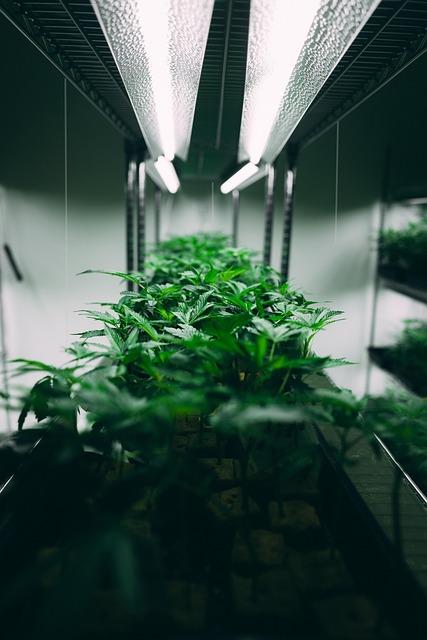
Think of the United States as a shifting atlas where the borders between legal and illegal aren’t drawn by rivers or mountain ranges but by chemistry,statutes and the occasional regulatory quirk.At the heart of that map is a small, unassuming molecule: THCA – the acidic precursor to THC that lives in raw cannabis plants and, when heated, becomes the psychoactive compound most people know as THC. Whether a product is legal can hinge on that subtle chemical change and on how a particular state chooses to count it.
This article unspools that knot: we’ll chart how states define and regulate THCA and THC, how federal standards intersect with local rules, and why the same jar of flower or cartridge can be legal in one jurisdiction and problematic in another. Along the way we’ll translate the science into plain language, highlight the key legal lines that matter to growers, retailers and consumers, and map the regulatory variations that turn a simple chemical conversion into a complex legal landscape.
No cartographer’s compass can replace careful reading of statutes or professional legal advice,but a clear map-built from science and law-can help you navigate where the lines are drawn and why they keep changing.
Understanding THCA and THC: Chemical differences and Legal Implications
THCA and THC are siblings on the cannabis molecule family tree, but a small chemical difference makes a big practical and legal gap. THCA (tetrahydrocannabinolic acid) carries a carboxyl group that prevents it from binding strongly to CB1 receptors, so it’s largely non-psychoactive in its raw form. When exposed to heat, light, or time, that carboxyl group is lost in a process called decarboxylation, transforming THCA into Δ9‑THC – the compound commonly responsible for psychoactive effects.That one-step change is why raw flower, tinctures, or cold-pressed extracts can behave very differently from smoked or cooked forms.
The law frequently enough hinges on that molecular switch. At the federal level the 2018 Farm Bill set a bright-line threshold for hemp based on Δ9‑THC concentration (0.3% dry weight), but states interpret and enforce limits in many ways. Some jurisdictions measure only Δ9‑THC; others calculate a total THC by converting THCA into its THC equivalent before comparing to legal limits. Because labs use a conversion factor to model this potential, a product’s legal classification can change depending on testing methodology and whether samples have been heated prior to analysis.
| molecule | Measured Value | Converted THC (example) |
|---|---|---|
| THCA | 1.00% | 0.877% (1.00 × 0.877) |
| Δ9‑THC | 0.20% | 0.20% |
| Total THC | – | 1.077% (0.20 + 0.877) |
Practical clarity for buyers and sellers:
- check the COA (Certificate of Analysis) to see whether labs report Δ9‑THC only or include total THC calculations.
- Confirm state testing rules before transporting or selling-what’s legal in one state may fail in another if THCA is counted differently.
- Mind processing and storage: heat and prolonged exposure can convert non-psychoactive THCA into regulated THC, changing both potency and legal status.
These chemical subtleties are why a product’s label, lab report, and the jurisdiction’s testing protocol matter as much as the plant itself.
State by State Rulebook: How Jurisdictions Treat THCA and intoxicating THC
Across the map, regulators have stitched together very different ways of treating THCA-the non‑intoxicating precursor in the plant-and the intoxicating delta‑9 THC that appears after heat or chemical transformation. Some jurisdictions focus strictly on the measured concentration of delta‑9 on a dry‑weight basis, while others aim to capture the full “total THC” picture by converting THCA into its potential delta‑9 equivalent for compliance. The result is a legal quilt where what’s lab‑legal in one place can be treated as a controlled product a few miles away.
Common regulatory flavors appear repeatedly,each carrying different implications for growers,processors and consumers.Regulators frequently enough fall into a few recognizable camps:
- Delta‑9 only – compliance based on measured intoxicating THC.
- Total THC – counts THCA after applying a conversion factor to reflect potential intoxication.
- Hybrid or program‑specific – different rules for hemp, medical cannabis, and adult‑use markets.
- Enforcement‑driven – nominal thresholds exist, but field enforcement and intent can change outcomes.
That variation shapes everything from lab methods and labeling to how dried flower, concentrates, and edibles are moved across lines. Labs are increasingly asked to report both forms-actual delta‑9 and THCA-plus a calculated “total THC” to keep producers compliant. For consumers, the practical takeaway is simple: check both the cannabinoid panel and the law where you are. Professionals also watch for rules about transportation and manifesting products, as a shipment that passes in one jurisdiction can trigger seizures in another that uses a different counting method.
| Regulatory Category | What It Counts | Typical Impact |
|---|---|---|
| Delta‑9 only | Measured intoxicating THC | Clear compliance for raw hemp biomass |
| Total THC | Delta‑9 + potential from THCA | Stricter; more products fail limits |
| Hybrid programs | Varies by product/market | Complex labeling and testing rules |

Testing,Conversion,and Enforcement: Practical Challenges for regulators and Producers
Laboratories and regulators frequently enough stare at the same numbers and see different realities. Analytical results for cannabinoids vary by method, instrument sensitivity, extraction protocol and even the chemist’s extraction time. The common conversion used to estimate potential psychoactive THC after decarboxylation – multiplying THCA by 0.877 – is a neat chemical shortcut, but its practical application stirs controversy: should regulators count that theoretical maximum as part of an on-paper THC limit, or only measure the actual delta‑9 THC present today? The answer determines whether a crop is legal at harvest, how a product must be labeled, and what penalties might apply months later after retail circulation and home decarboxylation.
On the enforcement side, realities like shipping delays, warming temperatures, and inconsistent sampling intensify the problem. Suppliers must contend with unpredictable lab results while inspectors wrestle with proving a product exceeded a statutory threshold at the time of sale. Common friction points include:
- Sampling variance – where one lab’s 0.30% delta‑9 can be another’s 0.50% for the same batch.
- Conversion counting – whether THCA is added into the legal THC tally after applying conversion factors.
- Storage effects – which can slowly convert THCA to THC before or after testing.
Practical compromise is possible: harmonized test methods, defined uncertainty bands, mandatory chain-of-custody and certified reference materials reduce disputes and litigation. Below is a simple snapshot of three enforcement philosophies and their trade-offs – a swift map for regulators and producers navigating legal lines.
| Approach | Quick Description | Producer Impact |
|---|---|---|
| total‑THC | Counts THC + (THCA × 0.877) | Conservative – tighter compliance, more testing |
| Delta‑9 Only | Measures active THC present now | Producer-pleasant, but may miss post-sale conversion |
| Hybrid/Tolerance | allows margin for lab error or short-term conversion | Balances enforcement and commercial viability |
Consumer Safety and Labeling Recommendations to Navigate Legal Gray Areas
Transparency is the best protection for both buyers and sellers when statutes blur the lines between raw THCA and activated THC. labels should read like a clear map: call out raw and decarboxylated cannabinoid levels, show per‑serving and per‑package potency, and give an easy path to the lab report. Even when the law is unsettled,straightforward details reduces accidental overconsumption and empowers consumers to make informed choices.
Practical label features to implement today include:
- Cannabinoid breakdown – list THCA and THC separately (mg/g and mg per serving).
- Activation warning – note that heating can convert THCA to psychoactive THC.
- Batch ID & COA QR – link directly to the third‑party Certificate of Analysis.
- Clear dosing – give microdoses and standard servings, plus onset/peak timelines.
- Jurisdiction note – a brief reminder that local laws may govern possession and use.
| Label Element | Purpose | Example |
|---|---|---|
| THCA (raw) | Shows non‑psychoactive starting material | 120 mg/package |
| THC (activated) | Estimated psychoactive potential after heat | Up to 96 mg/package (if fully decarbed) |
| COA QR | Verifies potency & contaminants | Scan for full lab report |
Beyond the sticker, safety is packaging and practice: use tamper‑evident, child‑resistant containers, include storage and disposal instructions, and train retail staff to explain how THCA behaves under heat. When uncertainty looms, adopt the precautionary principle-label conservatively, encourage low starting doses, and provide contact info for questions. Those small choices create predictable experiences for consumers and greater legal resilience for brands operating across shifting state lines.
The Conclusion
The landscape where chemistry and law meet is never static – it looks more like a living map than a finished chart. Whether you came for the technical distinctions between THCA and THC, the patchwork of state definitions, or the practical implications for businesses and consumers, the key takeaway is the same: the lines on this map change, and understanding both the science and the statutes is essential to finding your bearings.
Stay curious and cautious. Treat lab reports, statutes, and agency guidance as your compass and keep them close when you cross state lines or make product decisions. Where possible, confirm rules with official state resources or qualified counsel, and look for lab testing that clearly documents the chemical profile of products.
As the laws evolve and new rulings redraw boundaries,a little preparedness goes a long way. Keep watching the map, update your route, and you’ll be better equipped to navigate the shifting terrain between THCA and THC.

